
Do you know what Hyrox actually stands for?
I’m guessing not. Because if you knew, you’d probably vomit.
It stands for Hybrid Rockstar.
That’s right. You heard me. Hybrid. Rockstar.
Suddenly the attitude makes sense, doesn’t it? The strutting around the gym topless. The Instagram posts dripping with self-congratulation. They’re not just fitness enthusiasts – they’re rockstars.
Now that we’ve established the peak of fitness marketing cringe, let’s talk about why everyone’s suddenly doing this.
Hyrox is everywhere. Your Instagram feed is full of it. Every fitness influencer has suddenly discovered they’re a “hybrid athlete.” It’s the latest fitness trend that everyone’s jumping on, and like most fitness trends, there are some good reasons for its popularity – and some serious limitations nobody wants to talk about.
Why Hyrox Has Exploded
Let’s be fair first. There are legitimate reasons why Hyrox has taken off:
Community and Competition – People train together, compete together, have a shared goal. This is powerful. Most people training alone in commercial gyms have zero structure and no accountability. Hyrox gives them both. The competitive element drives people to actually show up and push harder than they would scrolling through their phones between sets.
Programming Done For You – The average person has no idea how to structure training. Hyrox removes that decision paralysis. You know exactly what you’re training for. The workouts are prescribed. You turn up, you do the work. For someone who’s been spinning their wheels for years, that clarity is valuable.
The Hybrid Athlete Appeal – Not everyone wants to be a meathead bodybuilder who can’t run for a bus. The idea of being both strong AND fit is appealing. Hyrox markets itself as the answer to that – functional fitness, real-world capable, hybrid athlete status. It sounds good.
And that’s where the problems start.
Where Hyrox Falls Short
Here’s what nobody wants to hear: Hyrox is predominantly a cardio event with some strength elements, not a true hybrid programme.
Look at the actual competition structure: 8km of running broken up by eight functional exercises. The running is the majority of the event. The strength components – sled pushes, sled pulls, sandbag carries, wall balls, rowing, ski erg – are all done in a fatigued state, relatively light, and for time.
This develops cardio endurance and muscular endurance. It does NOT develop maximal strength.
If your goal is genuinely to be a hybrid athlete – strong AND fit – Hyrox programming has a critical flaw: there’s nowhere near enough heavy strength work.
The Fundamental Problem: Concurrent Training
Here’s the reality that Hyrox ignores: to get really strong or really fit, you need to separate these qualities in your training.
The research on concurrent training – doing cardio and strength in the same session – is clear. It’s called the “interference effect,” first documented by Dr. Robert Hickson in 1980 and confirmed repeatedly since. When you combine high-intensity cardio with strength training, the adaptations for both are compromised compared to training them separately.
A 2012 meta-analysis published in the Journal of Strength and Conditioning Research analysed 21 studies and found that concurrent training significantly reduced strength gains compared to strength training alone – particularly in the lower body.
Why? Several mechanisms:
- Compromised Recovery – Your body can’t maximally adapt to two opposing stimuli simultaneously. Endurance training promotes mitochondrial biogenesis and oxidative enzymes. Strength training promotes muscle protein synthesis and neural adaptations. These pathways compete for limited recovery resources.
- AMPK vs mTOR – Endurance exercise activates AMPK, which inhibits mTOR – the primary pathway for muscle protein synthesis. You’re literally sending conflicting signals to your muscles.
- Glycogen Depletion – Heavy strength training requires full glycogen stores for maximal performance. If you’ve already depleted them with cardio, you can’t lift heavy enough to create the stimulus needed for strength gains.
- Neuromuscular Fatigue – This is where injury risk increases significantly. Heavy compound lifts – squats, deadlifts, presses – require precise motor patterns and full CNS output. When you’re pre-fatigued from cardio, your form deteriorates, your bar speed drops, and your injury risk skyrockets.
What Actually Works for Hybrid Performance
If you genuinely want to be both strong and fit – not just cardio fit with some muscular endurance – you need to structure training properly:
Separate Strength and Cardio Sessions – Ideally on different days. If same-day training is necessary, do strength first when you’re fresh, cardio after. Never the reverse.
Prioritise Heavy Strength Work – 3-4 sessions per week of actual heavy lifting. We’re talking 80-90% of max loads for squats, deadlifts, presses. This is what builds real strength. You can’t build this running between workout stations.
Periodise Your Training – Spend focused blocks building strength, then focused blocks building conditioning. Trying to maximise both simultaneously is the fastest way to become mediocre at both.
Use Appropriate Conditioning Methods – Not everything needs to be high-intensity intervals. Low-intensity steady state work (Zone 2 cardio) doesn’t create the same interference effect as high-intensity work. A 2016 study in Sports Medicine showed that low to moderate intensity cardio has minimal negative impact on strength gains.
The Bottom Line
Hyrox isn’t inherently bad. For someone who’s been doing nothing, it’s infinitely better than sitting on the sofa. The community aspect is powerful. The structure is valuable. The competitive element drives consistency.
But let’s be honest about what it is: a cardio-dominant fitness competition with strength-endurance components.
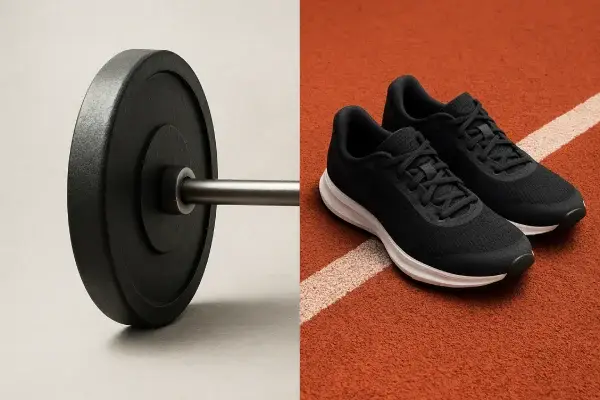
If your goal is to run a good Hyrox time, then train for Hyrox. But don’t confuse that with optimal hybrid athlete development. You’re not going to build serious strength doing wall balls in a fatigued state. You’re not going to deadlift impressive numbers when your training is structured around running 8km and hitting workout stations.
(If that’s you — you’ve got a race date and you want to prepare for it properly — we’ve broken down exactly how to structure the block: HYROX training London: the proven 12-week race prep plan.)
Real hybrid performance requires dedicated strength phases where you’re lifting heavy 3-4 times per week with proper recovery. Then dedicated conditioning phases where you build your engine without compromising your strength base.
Separate the stimuli. Respect the interference effect. Programme intelligently.
Or keep posting your Hyrox PRs on Instagram and wondering why you can’t squat bodyweight for reps. Your choice.
References
- Hickson RC. “Interference of strength development by simultaneously training for strength and endurance.” Eur J Appl Physiol Occup Physiol. 1980;45(2-3):255-263.
- Wilson JM, et al. “Concurrent training: a meta-analysis examining interference of aerobic and resistance exercises.” J Strength Cond Res. 2012;26(8):2293-2307.
- Coffey VG, Hawley JA. “The molecular bases of training adaptation.” Sports Med. 2007;37(9):737-763.
- Baar K. “Using molecular biology to maximize concurrent training.” Sports Med. 2014;44 Suppl 2:S117-125.
- Fyfe JJ, et al. “Interference between concurrent resistance and endurance exercise: molecular bases and the role of individual training variables.” Sports Med. 2014;44(6):743-762.
Murach KA, Bagley JR. “Skeletal Muscle Hypertrophy with Concurrent Exercise Training: Contrary Evidence for an Interference Effect.” Sports Med. 2016;46(8):1029-1039.
Frequently Asked Questions
Is Hyrox good for building muscle?
Hyrox is excellent for endurance and work capacity, but it isn’t optimised for muscle growth. If hypertrophy is your goal, you’ll need dedicated resistance training alongside it.
Is Hyrox suitable for beginners?
Yes, with preparation. The format is scalable, but going in unconditioned risks injury. A structured 8 to 12 week build-up is recommended.
How is Hyrox different from CrossFit?
Hyrox is a standardised, repeatable race (8 runs plus 8 functional stations), whereas CrossFit varies daily. Hyrox is easier to train for progressively.
How should I train for Hyrox?
Combine zone-2 running, compromised-running intervals and strength-endurance work. Our coaches build hybrid programmes that balance both without burning you out.
Ready to Train Smarter in North London?
Book a free, no-obligation 30-minute Strategy Call with BTX. We measure first, programme properly, then adjust from evidence.
Book Your Free Strategy Call