
Coming back from an injury is one of the hardest points in anyone’s training life. You want to move again, but you are unsure what is safe; you have been discharged from physiotherapy, but the gym floor feels like a risk. Our injury rehabilitation personal training Swiss Cottage service exists for exactly that gap: the stretch between clinical rehab and full, confident training.
This guide explains how injury rehabilitation personal training Swiss Cottage clients receive at BTX works, who it is for, how we work alongside physiotherapists and GPs, and what a typical return-to-strength programme looks like for clients in Swiss Cottage and the surrounding NW3 and NW6 neighbourhoods — the home of injury rehabilitation personal training Swiss Cottage residents can reach on foot.
Injury Rehabilitation Personal Training in Swiss Cottage: Where It Fits
To be clear about roles: we are personal trainers, not physiotherapists. Diagnosis and early-stage rehabilitation belong with your physiotherapist or GP. Where BTX comes in is the phase after clearance, when you are medically ready to rebuild but need structure, supervision and sensible progression. Many clients arrive with a discharge sheet of exercises and no idea how to turn it into a training plan; that translation is exactly what our injury rehabilitation personal training Swiss Cottage coaches do.
With your consent, we are happy to liaise with your physiotherapist directly, keep their movement restrictions front and centre, and report back on how you are progressing. That continuity is one of the main reasons local physios refer clients to our injury rehabilitation personal training Swiss Cottage service.
“The biggest mistake after an injury is doing nothing for too long. Once you are cleared to train, carefully loaded movement is what rebuilds the tissue, the strength and the confidence — that is what injury rehabilitation personal training Swiss Cottage style is for.” — James, BTX Coach
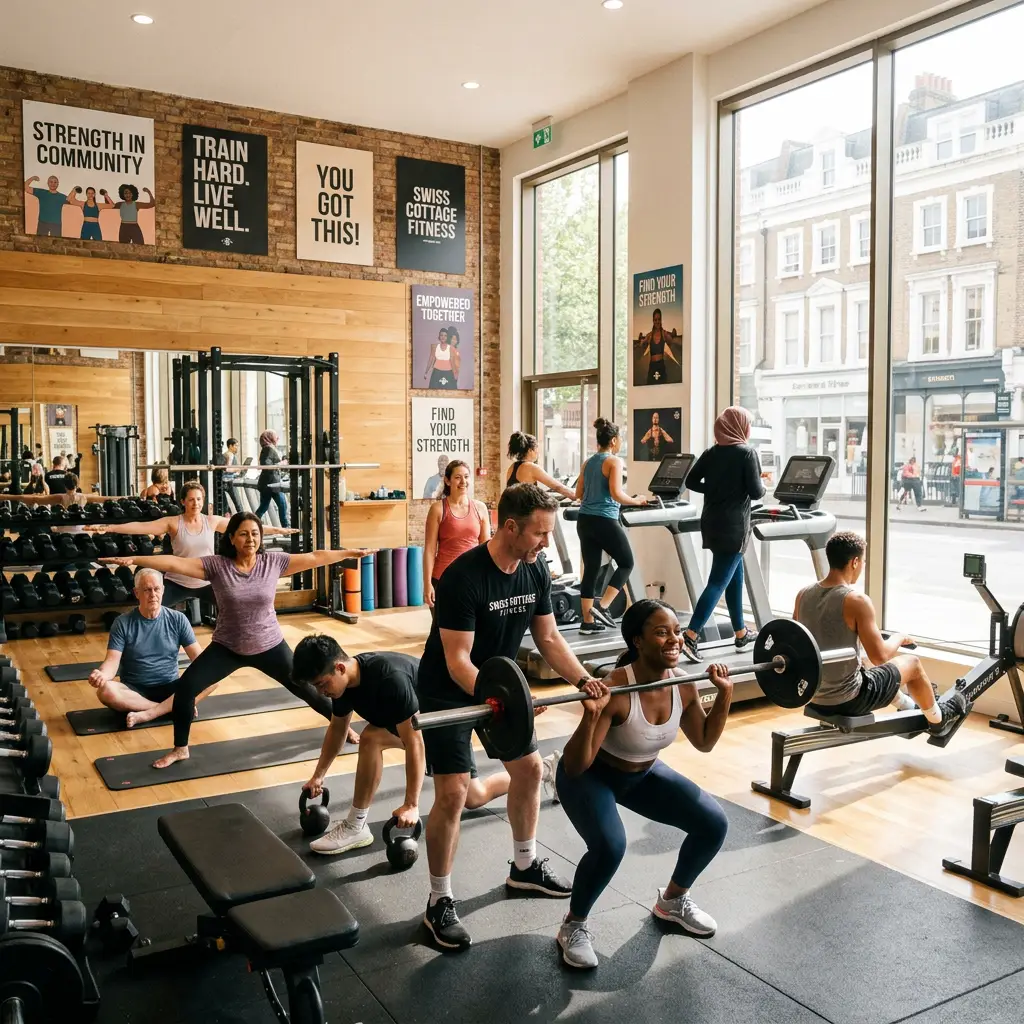
How Post-Injury Training Works at BTX
1. Assessment First, Always
Every programme starts with an InBody body composition scan and a detailed movement assessment. For rehab clients we add a careful history: what was injured, what treatment you had, what your clinician cleared you for, and what still feels uncertain. We test range of motion and baseline strength on both sides, because asymmetries tell us where to focus.
2. Graded, Individualised Loading
Rebuilding after injury follows a simple principle: progressive overload applied conservatively. We start lighter than you expect, restore full range of motion before chasing load, and progress one variable at a time — range, then volume, then intensity. Sessions are one-to-one, so every rep is watched and adjusted. Trainers like James, Giuseppe, Benjamin and Szymon coach the person in front of them, not a template.
3. Rebuilding the Engine Around the Injury
A knee or shoulder injury does not mean the rest of you stops training. We keep the uninjured areas strong and your conditioning ticking over, which protects your results and your morale. Recovery habits matter too: protein intake, sleep and daily walking all influence tissue repair, and our coaching covers them — our guide to omega-3s and recovery covers one frequently asked nutrition question in depth.
After any lower-body injury, practise sit-to-stand from a chair: 3 sets of 8 slow, controlled reps daily. It rebuilds leg strength through a safe range and gives you a simple, measurable marker of progress.
Not sure what is safe to do next? Every BTX rehab programme starts with an InBody scan and a movement assessment, and we are happy to work directly from your physio’s guidance.
Book a free strategy call with our coaches →What a Return-to-Strength Programme Looks Like
Every injury rehabilitation personal training Swiss Cottage plan is individual, but a typical post-injury month for a client might look like this:
Weeks 1–2 — Restore movement: controlled range-of-motion work, isometric holds, and light loading of the injured area alongside normal training for everything else. The goal is confidence and clean movement patterns.
Weeks 3–4 — Rebuild capacity: gradually loaded compound movements — squats, hinges, presses and rows scaled to your case — with volume increasing before intensity does.
Beyond week 4 — Return to performance: once strength is symmetrical and pain-free, injury rehabilitation personal training Swiss Cottage sessions transition you onto a standard progressive programme, whether your goal is personal training in Swiss Cottage for general strength or a fuller body transformation.
Timelines in injury rehabilitation personal training Swiss Cottage programmes vary with the injury, your history and your clinician’s advice — we would rather progress you a week late than a week early.
“Rehab training is where trust matters most. We progress one variable at a time, we listen to the body in front of us, and we never let ego set the loading.” — Giuseppe, BTX Coach
Why Clients Choose Our Injury Rehabilitation Personal Training in Swiss Cottage
BTX delivers injury rehabilitation personal training Swiss Cottage clients rate from a private studio, not a crowded chain gym. That matters for rehab: no queueing for equipment mid-superset, no pressure to keep up with a class, and a coach beside you for every rep. Our clients are mostly busy professionals and parents who want a structured, evidence-based route back to full training — delivered around their schedule, including early mornings and lunchtimes. If group energy suits you better once you are rebuilt, our fitness classes near Swiss Cottage are a natural next step.
Frequently Asked Questions
Do I need to finish physiotherapy before starting?
You should have clearance from your physio or GP to begin supervised exercise. Many clients overlap the late stage of physio with early training at BTX — with everyone’s knowledge and consent.
Can you liaise with my physiotherapist?
Yes, and we prefer to. With your consent we will follow their restrictions, use their discharge exercises as a starting point, and keep them informed of your progress.
Is personal training safe after surgery?
After surgical repair and clinical sign-off, supervised progressive training is generally an important part of a full recovery. We stay strictly within your surgeon’s or physio’s guidance and progress conservatively. Always confirm clearance with your clinician first.
How long until I am back to full training?
It depends on the injury, your training history and how your body responds. As a rough guide, most clients transition to a standard progressive programme within four to twelve weeks. We measure progress at every session rather than promising dates.
Ready to Rebuild, Properly?
Join Swiss Cottage locals who came back from injury with a plan instead of guesswork. Start with an InBody scan and a conversation.
Book Your Free Consultation at BTX →Ready to Train Smarter in North London?
Book a free, no-obligation 30-minute Strategy Call with BTX. We measure first, programme properly, then adjust from evidence.
Book Your Free Strategy Call